What Is a Phase 1 Environmental Site Assessment?

If you are buying, selling, financing, or developing commercial property, a Phase 1 Environmental Site Assessment is almost always the first environmental step. It is the standard due-diligence report that evaluates whether a property has a history of contamination before you take on ownership or lend against it. This guide explains in plain English what a Phase 1 ESA is, what it covers, what it does not cover, when you need one, and who is qualified to perform it.
What is a Phase 1 Environmental Site Assessment?
A Phase 1 ESA is a records-and-observation study, not a lab test. Its job is to identify whether current or past activity on a property, or on nearby properties, suggests a risk of contamination from hazardous substances or petroleum products. The deliverable is a written report that documents what the assessor found and states whether any environmental concerns, called Recognized Environmental Conditions, are present.
Because the assessment is based on records, visual inspection, and interviews rather than physical sampling, it is relatively fast and affordable. It is designed to flag potential problems so a buyer or lender can decide whether deeper investigation is warranted before money changes hands.
The ASTM E1527-21 standard
The governing standard is ASTM E1527-21, titled Standard Practice for Environmental Site Assessments: Phase I Environmental Site Assessment Process. The U.S. Environmental Protection Agency amended its All Appropriate Inquiries Rule, codified at 40 CFR Part 312, to recognize ASTM E1527-21 as a method for complying with the rule. In practice this means a Phase 1 ESA performed to E1527-21 is the version lenders, attorneys, and the EPA expect to see.
The standard matters for more than technical consistency. Following it is what allows a property owner to claim certain defenses to liability under the federal Superfund law, CERCLA. If the report does not meet the current standard, the legal protection it is meant to support can be at risk. That is why confirming the standard up front is not a formality.
The four components of a Phase 1 ESA
ASTM E1527-21 is built around four core elements. A complete report addresses all of them.
| Component | What it involves |
|---|---|
| Records review | Review of historical and regulatory records to reconstruct how the property and surrounding area have been used over time. The standard identifies four standard historical sources: aerial photographs, fire insurance maps, local street directories, and historical topographic maps. Regulatory databases are checked for known spills, permits, and listed sites. |
| Site reconnaissance | A physical walkthrough of the property by the environmental professional, looking for visible evidence of past or present releases, such as staining, drums, fill pipes suggesting buried tanks, or distressed vegetation. |
| Interviews | Interviews with current and past owners, operators, and occupants, and where relevant local officials, to fill gaps the records cannot. |
| Report | A written report that ties the findings together, includes a search for recorded environmental cleanup liens, and carries the environmental professional's declaration and conclusions on whether any Recognized Environmental Conditions exist. |
Under the 2021 standard, if the assessor does not review one of the four standard historical sources, the report must explain why it was not used. That requirement pushes for a more defensible historical picture of the site.
What is a Recognized Environmental Condition (REC)?
The central output of a Phase 1 ESA is its conclusion on Recognized Environmental Conditions. A REC is the presence, or the likely presence, of hazardous substances or petroleum products in, on, or at a property due to a release, a likely release, or conditions that pose a material threat of a future release. Put simply, a REC is a flag that contamination may be present and that further investigation may be appropriate.
The standard also uses two related terms for past issues:
- Historical REC (HREC): a past release that has been addressed to the satisfaction of the applicable regulatory authority and meets unrestricted use criteria, with no ongoing controls required. It is essentially a resolved issue.
- Controlled REC (CREC): a past release that has been addressed to the regulator's satisfaction, but where contamination is allowed to remain in place subject to required controls, such as a deed restriction or engineering control. It is resolved on paper but still carries conditions.
Understanding which category a finding falls into matters, because a live REC often leads to further testing, while an HREC or CREC changes how a buyer evaluates risk and ongoing obligations rather than always triggering new fieldwork.
What a Phase 1 ESA does not include
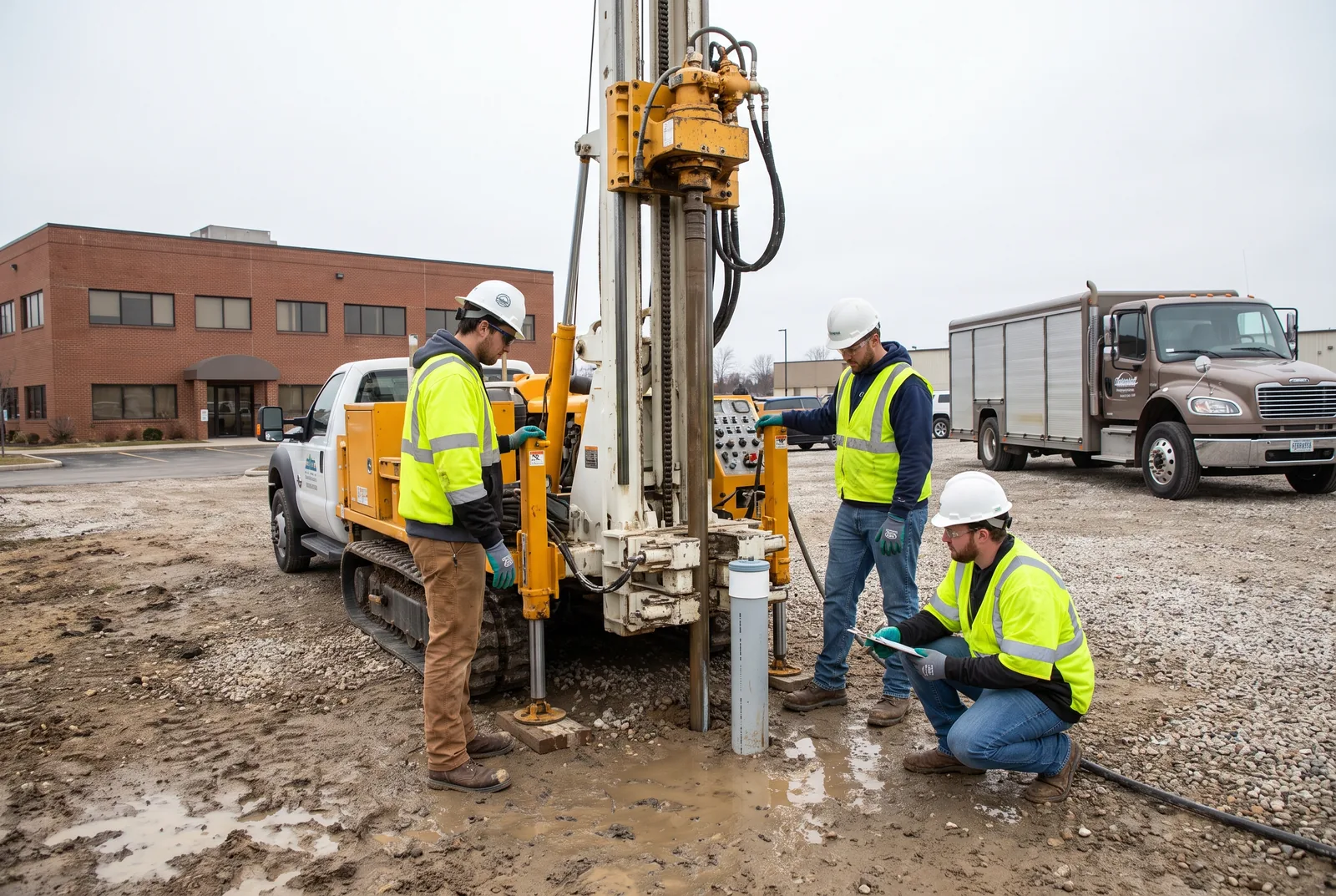
This is the most common point of confusion. A Phase 1 ESA does not involve collecting or testing physical samples. There is no drilling, no boring, and no laboratory analysis of soil, groundwater, soil vapor, or building materials. It is an evaluation of records and observable conditions only.
If the Phase 1 identifies a REC, the next step is a Phase 2 ESA, which is a separate and larger engagement that does include sampling and lab analysis to confirm whether contamination is actually present and, if so, its extent.
| Phase 1 ESA | Phase 2 ESA |
|---|---|
| Non-invasive: records, inspection, interviews | Invasive: physical sampling and testing |
| Identifies whether RECs may be present | Confirms whether contamination is actually present |
| No soil, water, vapor, or material samples | Collects and lab-tests soil, groundwater, vapor, or building materials |
| Typically 2 to 4 weeks | Longer and more costly; scope depends on the findings |
When and why you need one
A Phase 1 ESA is driven by two things: transactions and liability. The most common triggers are:
- Commercial real estate transactions. Buyers order a Phase 1 as standard due diligence before closing on commercial, industrial, or development property.
- Lender and loan requirements. Lenders routinely require a Phase 1 as a condition of financing. For SBA loans, environmental due diligence is required on loans involving real estate collateral. A Phase 1 is generally required for 504 loans involving real estate and for 7(a) loans over $150,000 secured by real estate. If the property's current or prior use matches an environmentally sensitive industry, a Phase 1 by a qualified professional can be required regardless of loan size.
- Liability protection under CERCLA. This is the legal reason the report exists. A properly conducted Phase 1 satisfies All Appropriate Inquiries, the federal standard a buyer must meet to qualify for CERCLA liability defenses, including the innocent landowner defense, the bona fide prospective purchaser defense, and the contiguous property owner defense. These defenses can shield a new owner from cleanup liability for contamination that predates their ownership. Without a compliant Phase 1, those protections may not be available.
Who can perform a Phase 1 ESA?
A Phase 1 ESA must be performed by a qualified Environmental Professional, a role defined in the EPA's rule at 40 CFR 312.10. The definition sets out qualifications based on a combination of education, training, and relevant experience, with the specific experience and education criteria described in ASTM E1527. In practice, Environmental Professionals are typically licensed engineers or geologists, or individuals with an environmental degree and several years of relevant site-assessment experience. The point of the requirement is that the person signing the report has the competence to identify environmental conditions and stand behind the conclusions.
How long it takes and how long it stays valid
A standard Phase 1 ESA generally takes about two to four weeks from engagement to final report. The pace is driven largely by how quickly regulatory records and historical sources come back. Many firms offer a rush option of roughly one week for an added fee when a closing is tight.
Timing of the report also matters after it is delivered. A Phase 1 is generally presumed valid for 180 days from the date of its key components, such as the site visit, the records review, the interviews, the lien search, and the professional's declaration. It can often still be used for up to one year if those components are updated. Beyond that window, a new or refreshed assessment is typically needed, which is worth planning around if your transaction timeline is long.
What it costs and what happens next
As an estimate, a standard Phase 1 ESA in the United States typically costs in the range of $1,500 to $3,000, with simple sites running lower and large, industrial, or multi-parcel properties running higher. Treat any figure as a starting point: price varies with property size, history, location, and turnaround.
If the report finds no RECs, the environmental step of your due diligence is usually complete and you can proceed. If it identifies one or more RECs, the recommended next step is a Phase 2 ESA to test for actual contamination. Knowing that path in advance helps buyers, lenders, and attorneys budget time and money realistically rather than being surprised late in a deal.
Frequently asked questions
What is a Phase 1 Environmental Site Assessment in simple terms?
It is a non-invasive due-diligence report, performed to the ASTM E1527-21 standard, that reviews a property's history and regulatory records, inspects the site, and interviews people familiar with it to identify any Recognized Environmental Conditions. It does not include any soil, water, or air sampling.
Does a Phase 1 ESA include soil or water testing?
No. A Phase 1 ESA is records and observation only, with no physical samples collected or lab-tested. If it identifies a potential concern, the sampling and lab analysis happen in a separate Phase 2 ESA.
When is a Phase 1 ESA required?
Most commonly before closing on commercial or industrial property, and when a lender requires it for financing. For SBA loans it is generally required on 504 loans involving real estate and 7(a) loans over $150,000 secured by real estate, and it is the basis for CERCLA liability protections such as the innocent landowner defense.
Who can perform a Phase 1 ESA?
A qualified Environmental Professional as defined in 40 CFR 312.10, which sets qualifications based on education, training, and experience. In practice these are typically licensed engineers or geologists, or professionals with an environmental degree and relevant site-assessment experience.
How long is a Phase 1 ESA valid?
A Phase 1 is generally presumed valid for 180 days from the date of its key components, and can often be used for up to one year if those components are updated. After that, a new or refreshed assessment is typically needed.
Get a Phase 1 ESA quote in 24 hours
Match with a vetted environmental firm in your area and get a firm price.
Get a 24-hr quoteThis article is general guidance only and is not legal or environmental advice. A Phase 1 ESA should follow ASTM E1527-21 and be performed by a qualified environmental professional, and timelines, costs, and figures vary by property, scope, and provider.